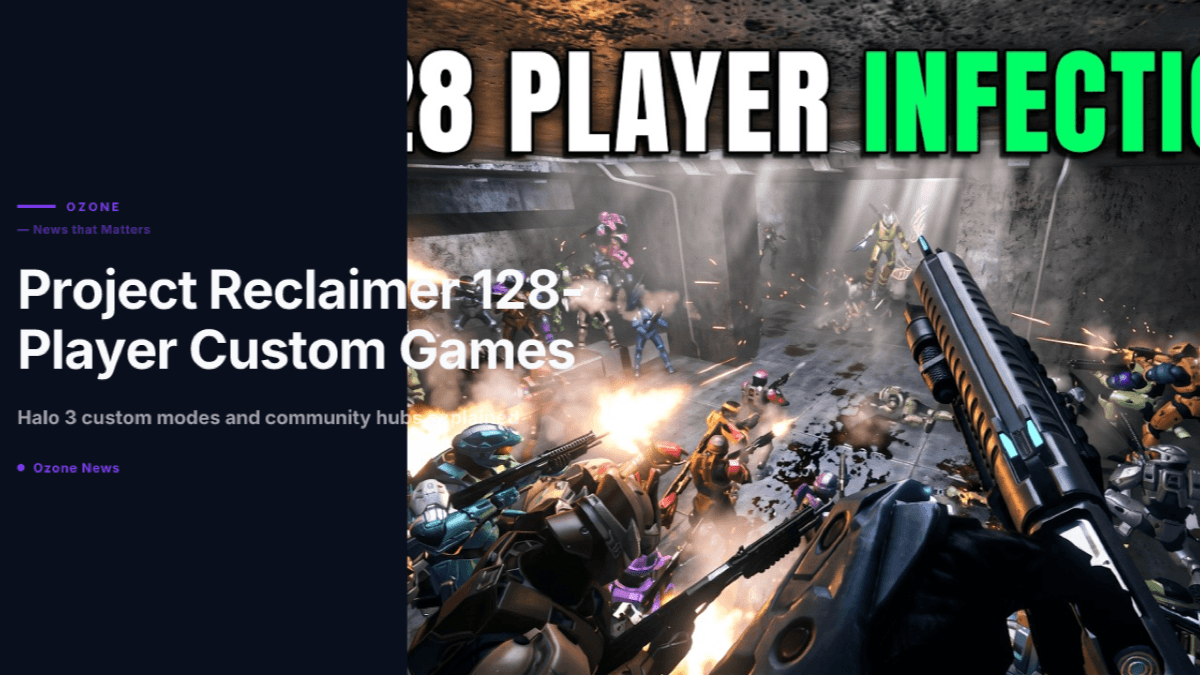
Halo 3 has always been remembered for Forge, custom games and the chaos that happens when players are given the right tools. Project Reclaimer is taking that idea to a scale Bungie's original Xbox 360 infrastructure could never support.
Community servers can now host up to 128 simultaneous players on PC. That turns familiar custom-game concepts into large sandbox events: dozens of Spartans defending a position from Infected players, 64v64 vehicle battles, and Forge-built raid maps that function more like cooperative scenarios than ordinary matchmaking.
128-player Infection is the flagship mode
The most immediate draw is 128-player Infection. Instead of a small group holding a familiar map against a handful of infected players, teams of more than 100 human Spartans can build defensive lines across large custom Forge spaces. Once the Infected break through, the match becomes a moving wave of escapes, last stands and improvised routes.
The scale changes the role of every player. Some Spartans hold the main entrance, others watch flanks or cover elevated sightlines, and the Infected can create pressure in multiple locations at once. It is still recognizably Halo 3 Infection, but the social coordination looks closer to a community event than a standard custom lobby.
64v64 BTB turns vehicles into the main event
Project Reclaimer also expands Big Team Battle into 64v64 matches. The larger player count makes vehicle control, air support and map movement central to the outcome. Expanded terrain gives Falcons, Hornets, Warthogs and heavy armor room to operate simultaneously instead of turning every vehicle spawn into an immediate traffic jam.
With 128 players on the field, one team can coordinate air transport while another pushes armor through a contested route. The result is the kind of combined-arms sandbox that Halo 3 suggested but could never deliver at this population.
Duck Hunt, Juggernaut and Forge raid creations
The community has also scaled classic party modes. In 100-plus-player Duck Hunt, snipers occupy elevated platforms while waves of runners cross obstacle courses below. Juggernaut uses the same population boost to create a moving target that entire groups must track and overwhelm.
Forge creators are using raised entity limits to build moving mega-structures, linear endurance runs and PvE gauntlets. The brief describes maps reaching up to 1,000,000 points, allowing creators to assemble larger environments and more elaborate set pieces than standard Forge sessions permit.
Where players coordinate events and assets
High-capacity custom games need more coordination than a normal matchmaking queue. Players use community hubs to find server links, download assets, check schedules and join organized events. The following resources were supplied for this coverage and should be treated as community directories rather than official Microsoft services.
- Reclaimer Hub: server statistics, event scheduling, ladders and custom-game coordination.
- HaloBase: a directory-style network for dedicated servers, tools and community groups.
- Halo Modding Reclaimers: technical discussion for mod creators, hosts, map designers and client updates.
- HaloCustoms: Looking-For-Group sessions, curated map packs and organized custom nights.
Why the 128-player ceiling matters
The technical achievement is only half the story. Halo 3's custom-game culture has always been about players creating experiences that the original developers did not need to anticipate. A higher server ceiling gives those creators room to make battles with distinct roles, more complex objectives and the kind of unpredictable player interactions that made Forge memorable in the first place.
Project Reclaimer is therefore less about replacing normal Halo 3 multiplayer and more about opening a parallel sandbox. Players who want classic 4v4 or ordinary BTB can still play familiar modes. Players who want a 128-person Infection defense or a community-built raid can find those through the hubs organizing events and assets.